






Mga Spotlight
Infant Development Specialist, Toddler Development Specialist, Early Childhood Development Specialist, Developmental Support Specialist, Infant and Family Specialist, Early Intervention Practitioner, Child Development Consultant, Family-Centered Intervention Specialist, Developmental Therapist, Pediatric Development Specialist, Early Childhood Support Coordinator, Child and Family Development Specialist
Imagine working with a two-year-old who is struggling to say their first words, or helping a baby learn how to sit, crawl, or interact with others. Infant Toddler Developmental Specialists are the professionals who step in during these important early years to help young children build the skills they need to grow and thrive. Through play, songs, stories, games, and everyday activities, they turn ordinary moments into learning opportunities. One child might be learning how to communicate their needs, while another is working on walking independently or playing with other children. Every small achievement—a first word, a first step, or a new social skill—can be a major milestone, and these specialists are there to guide and celebrate each success!
But their job isn't just about working with children. They also become trusted partners for families who may be worried about their child's development. They show parents and caregivers simple ways to encourage learning at home, answer questions, and help them understand their child's unique strengths and challenges. Part teacher, part coach, and part advocate, Infant Toddler Developmental Specialists help create a support system that gives children the best possible start in life. Their work can have a lasting impact, helping young children gain confidence, develop essential skills, and prepare for future success in school and beyond.
- Helping infants and toddlers reach important developmental milestones during their earliest years of life
- Supporting families by providing guidance, encouragement, and practical strategies for everyday learning
- Making a positive difference during a critical stage of growth when intervention can have lifelong benefits
- Celebrating meaningful achievements such as a child's first words, steps, or social interactions
- Empowering parents and caregivers to become active partners in their child's development
Iskedyul ng Paggawa
Infant Toddler Developmental Specialists generally work full-time, though part-time opportunities may be available. Most services are delivered during daytime hours, but schedules can vary depending on family availability. Many specialists travel between homes, childcare programs, early learning centers, clinics, and community agencies throughout the day.
Karaniwang mga Tungkulin
- Conduct developmental screenings and ongoing assessments
- Evaluate a child's strengths, needs, and developmental progress
Create individualized developmental support plans - Deliver intervention services through play-based learning activities
- Support development in communication, motor skills, cognition, social-emotional growth, and adaptive behavior
- Coach parents and caregivers on strategies that encourage learning at home
- Monitor and document developmental progress
- Collaborate with therapists, pediatricians, educators, and social service professionals
- Participate in family meetings and multidisciplinary team discussions
- Recommend community resources and support programs
- Assist families during transitions to preschool or other educational services
- Maintain accurate records, reports, and case documentation
- Advocate for children and families receiving intervention services
Mga Karagdagang Responsibilidad
- Educate caregivers about developmental milestones
- Promote inclusive learning opportunities for young children
- Provide guidance on creating supportive home environments
- Participate in community outreach and developmental awareness programs
- Stay informed about current research and intervention methods
- Support early identification initiatives for developmental concerns
- Assist with program development and quality improvement efforts
- Participate in continuing education and professional training
Your morning might begin with a visit to a toddler who is learning to say new words or take a few independent steps. Through songs, storybooks, games, and play-based activities, you help young children build important developmental skills while making learning fun and engaging.
As an Infant Toddler Developmental Specialist, you spend time working directly with children and coaching parents on simple strategies they can use during everyday routines. You may visit homes, childcare centers, or community programs, collaborating with families, therapists, and educators to support each child's growth and development.
Every day brings exciting milestones. One child may point to an object for the first time, while another may learn a new word or successfully interact with a peer. These small victories add up to meaningful progress, making each day both rewarding and inspiring!
Mga Malambot na Kasanayan
- Pagkamahabagin
- Pasensya
- Aktibong pakikinig
- Strong verbal communication
- Sensitibidad sa kultura
- Kakayahang umangkop
- Kritikal na pag-iisip
- Paglutas ng problema
- Katatagan sa emosyon
- Kolaborasyon
- Observation skills
- Organisasyon
- Pamamahala ng oras
- Pagkamalikhain
- Family-centered communication
Mga Kasanayang Teknikal
- Developmental screening and assessment
- Knowledge of infant and toddler development
- Individualized intervention planning
- Play-based intervention techniques
- Progress monitoring and data collection
- Family coaching and education
- Developmental milestone tracking
- Behavioral observation
- Documentation and case management
- Referral coordination
- Child-centered instructional strategies
- Use of developmental assessment tools
- Program planning and evaluation
- Collaboration with multidisciplinary teams
- Developmental Delay Specialist: Works with children experiencing delays in cognitive, communication, motor, or social-emotional development.
- Family Support Specialist: Focuses on helping parents and caregivers understand developmental needs and implement effective strategies at home.
- Autism Early Intervention Specialist: Provides specialized support for infants and toddlers showing signs of autism spectrum disorder.
- Developmental Therapist: Uses structured developmental activities to strengthen learning, communication, and adaptive skills.
- Inclusion Specialist: Helps children participate successfully in childcare, preschool, and community programs alongside their peers.
- Home-Based Intervention Specialist: Provides services primarily within family homes and natural learning environments.
- Early intervention and infant development programs
- Child development and assessment centers
- Hospitals and pediatric healthcare systems
- Pediatric therapy and rehabilitation clinics
- Public school districts and special education programs
- Regional centers serving children with developmental disabilities
- Government agencies focused on child and family services
- Early Head Start and early childhood education programs
- Family resource and support centers
- Nonprofit organizations serving children with special needs
Preparing for a career as an Infant Toddler Developmental Specialist requires significant education, training, and practical experience. Students often spend years studying child development, special education, psychology, or related fields while gaining hands-on experience working with young children and families.
The job can be emotionally challenging because specialists often support families who are navigating developmental concerns, medical diagnoses, or uncertainty about their child's future. Frequent travel between service locations, detailed documentation requirements, and the need to adapt intervention plans for each child can also be demanding.
Despite these challenges, many specialists find the work highly meaningful because they play an important role during one of the most influential stages of a child's life. Small developmental gains often represent major victories for both children and families.
- Increased emphasis on family-centered intervention models
- Expansion of home-based and community-based services
- Growing use of tele-intervention and virtual parent coaching
- Earlier identification of developmental concerns through screening programs
- Increased demand for autism-related services
- Greater focus on social-emotional development in infancy and toddlerhood
- Use of digital assessment and progress-tracking tools
- Stronger collaboration between healthcare, education, and social service systems
- Increased support for inclusive early childhood education
- Greater awareness of developmental and mental health needs in young children
Many Infant Toddler Developmental Specialists discovered their interest in this field at an early age. They often enjoyed caring for younger siblings, cousins, or neighbors and found themselves naturally drawn to helping children learn and grow. As kids, they may have loved playing teacher, doctor, or caregiver during pretend games, reading stories to younger children, or volunteering as babysitters. Many also enjoyed helping classmates understand difficult concepts, participating in mentoring or leadership activities, and finding ways to support others.
They were often curious about how children think, learn, and develop, and enjoyed creative activities such as arts, crafts, music, and imaginative play. Many were involved in community service projects or youth programs where they could make a positive difference in people's lives. Above all, they gained satisfaction from seeing others succeed and felt rewarded when they could help someone learn a new skill, overcome a challenge, or build confidence.
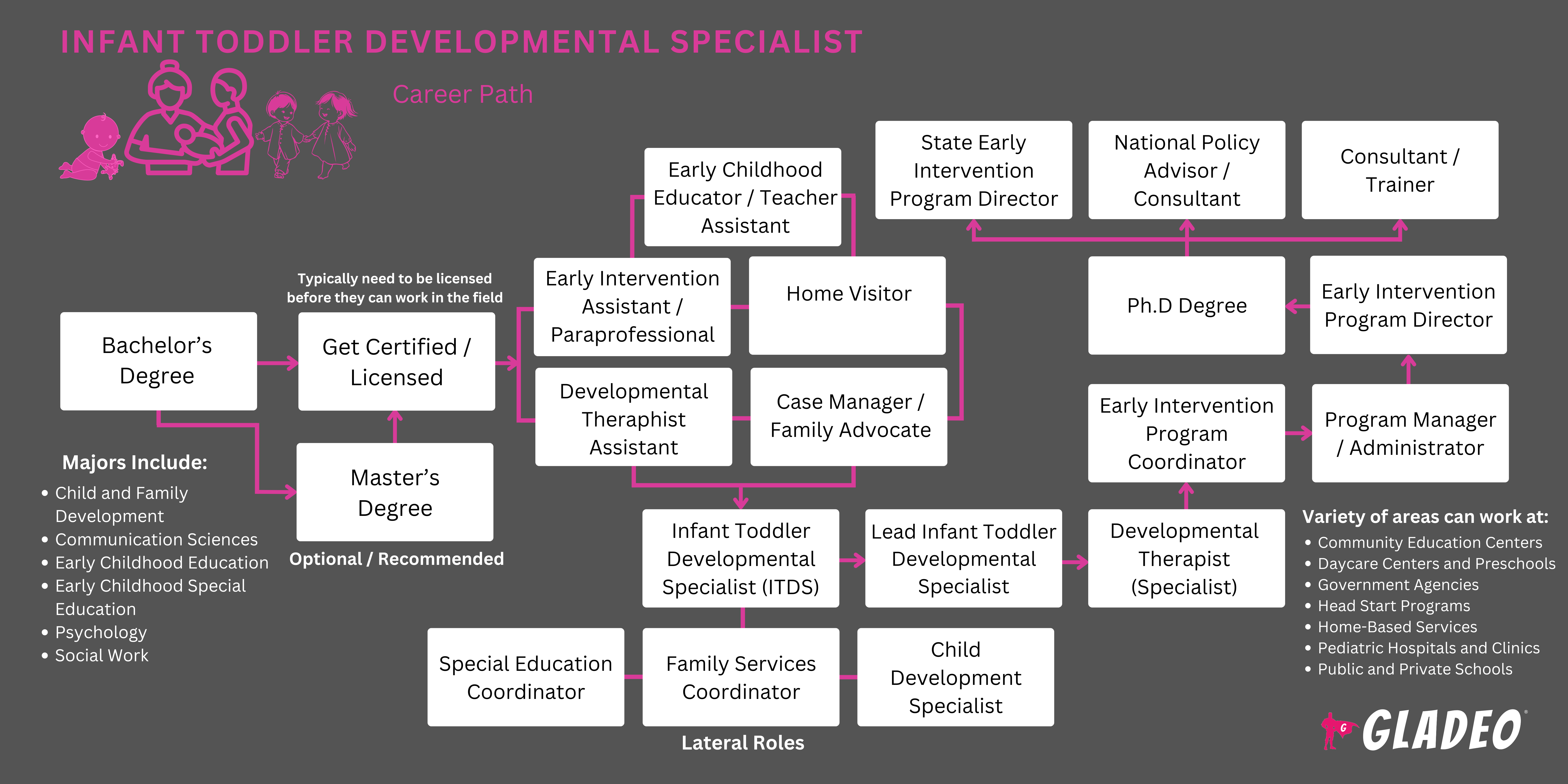
- Most positions require a bachelor's degree in child development, early childhood education, special education, psychology, family studies, or a related field
- Some employers prefer candidates with master's degrees, particularly for advanced intervention roles
- Practical experience working with infants, toddlers, and families is highly valued
- Internships, practicums, and field placements provide essential hands-on training
- Knowledge of developmental assessment and intervention methods is often required
- Training requirements vary depending on the employer and population served
- Additional certifications may strengthen employment opportunities
- Continuing education is important for staying current with research and best practices
- Some positions may require state-specific credentials or licensure
- Take courses in psychology, child development, education, and health sciences to build a strong foundation in how children grow and learn
- Volunteer in daycare centers, preschools, or community youth programs to gain hands-on experience with young children
- Participate in peer mentoring or leadership activities to strengthen communication and guidance skills
- Learn about developmental milestones and early learning principles to understand how children progress at different stages
- Observe professionals working in schools, clinics, or early intervention programs to see real-world practice in action
- Complete internships in educational, healthcare, or early intervention settings for practical experience
- Develop strong communication, patience, and teamwork skills through school and community activities
- Attend workshops or trainings related to child development and special education
- Join student organizations focused on education, psychology, or human services
- Read books, articles, and current research on early childhood development and intervention
- Courses that focus on child development from birth through age three, including cognitive, social, emotional, and physical development
- Hands-on training opportunities such as practicums, internships, or supervised fieldwork with infants and toddlers
- Programs that include early intervention strategies and special education foundations
- Training in communication skills for working with families, caregivers, and multidisciplinary teams
- Opportunities to learn assessment and observation techniques for tracking developmental progress
- Instruction on creating individualized learning and intervention plans for young children
- Exposure to real-world settings such as early intervention centers, clinics, or early childhood programs
- Experienced instructors who have backgrounds in early childhood education, special education, or child psychology
- Courses that emphasize cultural sensitivity and working with diverse families and communities
- Programs that prepare students for required certifications, licensing, or state-based early intervention credentials
- Because there is a growing need for Infant Toddler Developmental Specialists, opportunities in this field are expected to increase—but getting your first job still takes preparation and effort, so it’s important not to take anything for granted.
- Complete the required education and training in child development, early intervention, or a related field, and if possible, go beyond the minimum requirements by gaining additional certifications or specialized coursework that will help you stand out to employers.
- Carefully read job descriptions and make sure you meet all listed qualifications before applying, since many employers look for specific experience working with infants, toddlers, or children with developmental delays.
- Pay attention to keywords used in job postings, and include those same terms in your resume to better match what hiring managers are looking for.
- Highlight your hands-on experience in detail, including internships, volunteer work, or practicum experiences, and clearly explain the impact you made while working with children and families.
- Use job search platforms like Indeed, Glassdoor, and LinkedIn, but also check early intervention agencies, school district websites, and healthcare organization career pages for more targeted opportunities.
- Build and use your professional network, since many jobs are filled through connections with teachers, supervisors, mentors, or classmates who may know about openings.
- Ask professors, internship supervisors, or program coordinators if they can serve as references or write recommendation letters that highlight your strengths and experience.
- Prepare thoroughly for interviews by researching early childhood development topics, understanding the needs of families and communities you may serve, and practicing how you will explain your experience and skills.
- Finally, dress professionally and present yourself with confidence, showing that you are responsible, prepared, and ready to work with young children and their families in a supportive and professional way.
- Stay current with new research, strategies, and best practices in early childhood development through ongoing learning and training
- Pursue additional certifications in areas like early intervention, special education, autism support, or infant mental health to strengthen expertise
- Maintain a strong professional reputation by being reliable, compassionate, and committed to supporting children and families
- Build meaningful relationships with schools, healthcare providers, early intervention agencies, and community organizations
- Deepen your understanding of your local community, including family needs, barriers to services, and gaps in access or support
- Advocate for children and families by promoting fairness, inclusion, and better access to developmental services
- Gain experience in a variety of settings to broaden skills and increase career opportunities
- Participate in professional conferences, workshops, and training events to expand knowledge and network with other professionals
- Get involved in professional organizations related to early childhood development and intervention
- Share your expertise through presentations, trainings, mentoring, or collaboration with other specialists
- Build your professional presence by contributing to community programs, writing, or participating in outreach efforts
Mga Website
- Zero to Three (early childhood development and infant mental health resources)
- American Academy of Pediatrics
- Early Childhood Technical Assistance Center (ECTA)
- Individuals with Disabilities Education Act (IDEA) resources
- Division for Early Childhood (DEC) of the Council for Exceptional Children
- Centers for Disease Control and Prevention (CDC) – Child Development
- Head Start and Early Head Start programs
- National Association for the Education of Young Children (NAEYC)
- Association of Infant Mental Health (AIMH)
- National Early Childhood Technical Assistance System
Mga Libro
- Infants, Toddlers, and Caregivers: A Curriculum of Respectful, Responsive Care and Education by Janet Gonzalez-Mena and Dianne Widmeyer Eyer
- The Early Intervention Guidebook for Families and Professionals by Bonnie Keilty
- Developmental Profiles: Pre-Birth Through Adolescence by Gretchen Gimpel Peacock and Lee M. Futrell
- Young Children with Special Needs by Jane S. R. Case-Smith and Pat Mirenda
- Early Childhood Intervention: A Multicultural Perspective by Barbara J. Kaiser and Judy Sklar Rasminsky
Infant Toddler Developmental Specialists can have meaningful but also emotionally and physically demanding jobs. They carry a big responsibility in supporting children during the most important stage of early development. While this career is deeply rewarding for many, it may feel too intensive for others who prefer less hands-on or emotionally involved work. A few alternative careers to consider include:
- Child Development Specialist
- Preschool Teacher
- Early Childhood Special Education Teacher
- Speech-Language Pathology Assistant
- Katulong sa Occupational Therapy
- Espesyalista sa Buhay ng Bata
- Family Support Specialist
- Behavioral Support Assistant
- School Counselor (Early Childhood Focus)
Balita

Mga Itinatampok na Trabaho
Mga Online na Kurso at Kagamitan
Mga Inaasahang Taunang Sweldo
Ang mga bagong manggagawa ay nagsisimula sa humigit-kumulang $45K. Ang median na suweldo ay $49K bawat taon. Ang mga manggagawang may mataas na karanasan ay maaaring kumita ng humigit-kumulang $63K.
Mga Inaasahang Taunang Sweldo
Ang mga bagong manggagawa ay nagsisimula sa humigit-kumulang $39K. Ang median na suweldo ay $46K bawat taon. Ang mga manggagawang may mataas na karanasan ay maaaring kumita ng humigit-kumulang $55K.
Mga Inaasahang Taunang Sweldo
Ang mga bagong manggagawa ay nagsisimula sa humigit-kumulang $44K. Ang median na suweldo ay $49K bawat taon. Ang mga manggagawang may mataas na karanasan ay maaaring kumita ng humigit-kumulang $61K.
Mga Inaasahang Taunang Sweldo
Ang mga bagong manggagawa ay nagsisimula sa humigit-kumulang $38K. Ang median na suweldo ay $42K bawat taon. Ang mga manggagawang may mataas na karanasan ay maaaring kumita ng humigit-kumulang $50K.
Mga Inaasahang Taunang Sweldo
Ang mga bagong manggagawa ay nagsisimula sa humigit-kumulang $38K. Ang median na suweldo ay $46K bawat taon. Ang mga manggagawang may mataas na karanasan ay maaaring kumita ng humigit-kumulang $51K.
Mga Inaasahang Taunang Sweldo
Ang mga bagong manggagawa ay nagsisimula sa humigit-kumulang $38K. Ang median na suweldo ay $46K bawat taon. Ang mga manggagawang may mataas na karanasan ay maaaring kumita ng humigit-kumulang $51K.