









Mga Spotlight
Agriculture Teacher, Agricultural Education Instructor, Agri-Science Educator, Agribusiness Instructor, Vocational Agriculture Teacher
The world’s population is now over 8 billion people! It has tripled in just the past 70 years, putting a strain on resources—including food!
The field of agriscience seeks to boost food production in a sustainable, eco-friendly way, using technologies and practices that will help ensure the population has enough food in the coming years.
Agriscience Teachers are vital for raising awareness of this important field, by teaching classes about agriculture, plant and animal science, soil and water conservation, and natural resource management. Courses may include field trips and hands-on activities for learners to gain practical experience.
At the high school level, teachers may serve as advisors for their school’s Future Farmers of America chapters. College instructors and professors may also collaborate with external partners in the local agribusiness industry.
- Showing students the importance of the agricultural sector and its workers
- Doing their part to ensure the world has enough to eat
- Impacting the physical health and well-being of communities
Iskedyul ng Paggawa
- Agriscience Teachers work full-time, Monday through Friday. They may work overtime to prepare lessons and activities, grade assignments, or serve on committees. They must also spend time keeping up with changes in their respective fields. In addition, there may be evening activities to attend or supervise.
- At the college level, agriscience educators are often required to engage in research and attend professional organization events. They must also research, write, and publish scholarly articles.
- Sa mga panahong walang pasok (ibig sabihin, mga bakasyon sa tag-init at mga pista opisyal), maaaring mas kaunti ang trabaho, ngunit kailangan pa ring maghanda ang mga guro para sa mga paparating na termino.
Karaniwang mga Tungkulin
Antas ng Mataas na Paaralan
- Suriin ang mga aklat-aralin at lumikha ng mga aralin batay sa mga layunin sa pagkatuto ng pangunahing kakayahan para sa baitang na itinuturo
- Use a variety of methods and instructional materials to keep learners engaged
- Explain the different career fields within the agricultural sector and its industries
- Organize individual/group activities to develop agriculture knowledge and skills
- Prepare activities and materials. Incorporate digital classroom best practices
- Provide opportunities for students to get hands-on experience. Plan and carry out supervised field trips to agriscience-related sites
- Manage the school’s laboratory and equipment, if applicable
- Mag-set up ng mga kagamitang audio/visual o computer; magbigay ng mga lektura at presentasyon
- Monitor student behavior and progress. Enforce classroom/district rules, model proper behavior, and ensure understanding and compliance
- Lumikha ng mga inklusibong kapaligiran kung saan maaaring magpokus ang mga mag-aaral at makaramdam ng suporta
- Support agriculture learning opportunities, such as the Supervised Agricultural Experience, and clubs such as Future Farmers of America! Prepare FFA rosters and registrations
- Keep an eye on unique learner situations, to provide support as needed
- Prepare students for standardized tests. Record performance and offer insights about strengths and areas for improvement
- Magtalaga at magbigay ng marka sa takdang-aralin. Suriin ang mga paksa ng pagsusulit at pagsusulit
- Track attendance; calculate grades
Antas ng Kolehiyo
- Develop and teach a rigorous agriscience curriculum that prepares students for post-graduate careers
- Ensure the college department’s student learning objectives are met
- Provide engaging lectures and presentations that keep students interested
- Work with the program department to offer and support opportunities for students to get hands-on experience via internships/cooperative education activities
- Assign reading, essay writing, activities, and projects to develop agriscience-specific knowledge and applied skills
- Ipatupad ang mga tuntunin sa silid-aralan at kolehiyo at maging huwaran ng wastong pag-uugali
- Meet with students during office hours to answer questions. Refer students to academic advisors, as needed
- Mga takdang-aralin at pagsusulit para sa mga grado
- Collaborate with fellow instructors/professors to create new program curricula, including distance learning programs
Mga Karagdagang Responsibilidad
- Makipagkita sa mga dekano ng kolehiyo at mga pinuno ng paaralan upang magbigay ng feedback sa tagumpay ng programa
- Conduct research, apply for grants, and write scholarly articles for academic journals
- Participate in professional organizations; contribute to the advancement of agriscience fields
- Pangasiwaan o gabayan ang mga teaching assistant at post-doc researchers
- Familiarize new instructors and adjunct professors with programs
- Serve on institutional committees (such as hiring committees)
- Stay on top of agriscience trends to ensure the curriculum is up-to-date
- Trabaho sa mga kwalipikasyon sa panunungkulan
Mga Malambot na Kasanayan
- Kakayahang subaybayan at suriin ang kilos ng mag-aaral
- Pagkamahabagin
- Katahimikan
- Pag-uugnay at pagtuturo ng mga aktibidad
- Pagnanais at kakayahang tumulong sa iba na magtagumpay
- Empatiya
- Mahusay na kasanayan sa organisasyon
- Imbestigador
- Mga kasanayan sa pakikipag-ugnayan
- Pamumuno
- Obhetibo
- Pasensya
- Katatagan
- Kakayahang maging maparaan
- Kamalayan sa lipunan at kultura
- Mahusay na pagpapasya at paghuhusga
- Malakas na kasanayan sa komunikasyon, kabilang ang aktibong pakikinig
Mga Kasanayang Teknikal
- Ability to work with animals, if teaching animal science
- Expertise in agriscience topics (either generalized or specialized), such as genetics, plant physiology, and soil science
- Familiarity with basic crop production practices, farm machines, and equipment
- Familiarity with educational software and databases
- Familiarity with lab instruments and testing tools
- Knowledge of math (arithmetic, algebra, geometry, calculus, statistics), biology, chemistry, and geography
- Knowledge of tablets, printers/scanners, and presentation equipment
- Pag-unawa sa mga kasanayan at layunin ng pagkakaiba-iba, pagkakapantay-pantay, at pagsasama
- Mga institusyong pang-edukasyon
- Local, state, and federal governmental agencies
Agriscience Teachers need patience and enthusiasm to teach in modern classrooms. While many students are good with agricultural and STEM subjects, others may struggle…and some may simply not be interested!
It’s vital to teach agriscience in a way that is interesting and helps everyone feel supported while staying on target with learning objectives. Since science and technology are always evolving, teachers must keep up with changes and use current instructional material and teaching methods.
They also have to put in sufficient time to prepare for each class, grade assignments with care, track student progress, and manage administrative duties. There may be Supervised Agriculture Experience and Future Farmer of America-related tasks to attend to, as well. All in all, it’s a lot of work—but the world of agriscience depends heavily on agriscience teachers to educate and motivate learners who may one day opt to enter these critical career fields.
Three hot trends in agriscience are precision agriculture, sustainable practices, and vertical farming!
Precision agriculture relies on smart technology to collect and analyze data about crops and livestock. The results are used to help farmers make better decisions so they can boost yields, reduce costs, and cut waste.
This ties into sustainable agriculture, which minimizes environmental impact and preserves natural resources. Practices include crop rotation, cover crops, and integrated pest management (to reduce reliance on synthetic fertilizers and pesticides)
Vertical farming, as the name suggests, is the practice of growing crops in vertically stacked layers. This uses much less land and allows for vastly more efficient utilization of water resources (in some cases, using 99% less water than traditional farming methods)!
People who are drawn to becoming Agriscience Teachers probably loved being outdoors, working on farms or in gardens. Most likely, they have always cared about the fragile ecosystems all around us, even as kids. They may have yearned to understand the wondrous science behind these things. After learning, they might have enjoyed sharing the information with others—thus beginning their journeys to becoming teachers!
- Education and training requirements for teachers vary by state, school type, and career goals (i.e., the level you want to teach at)
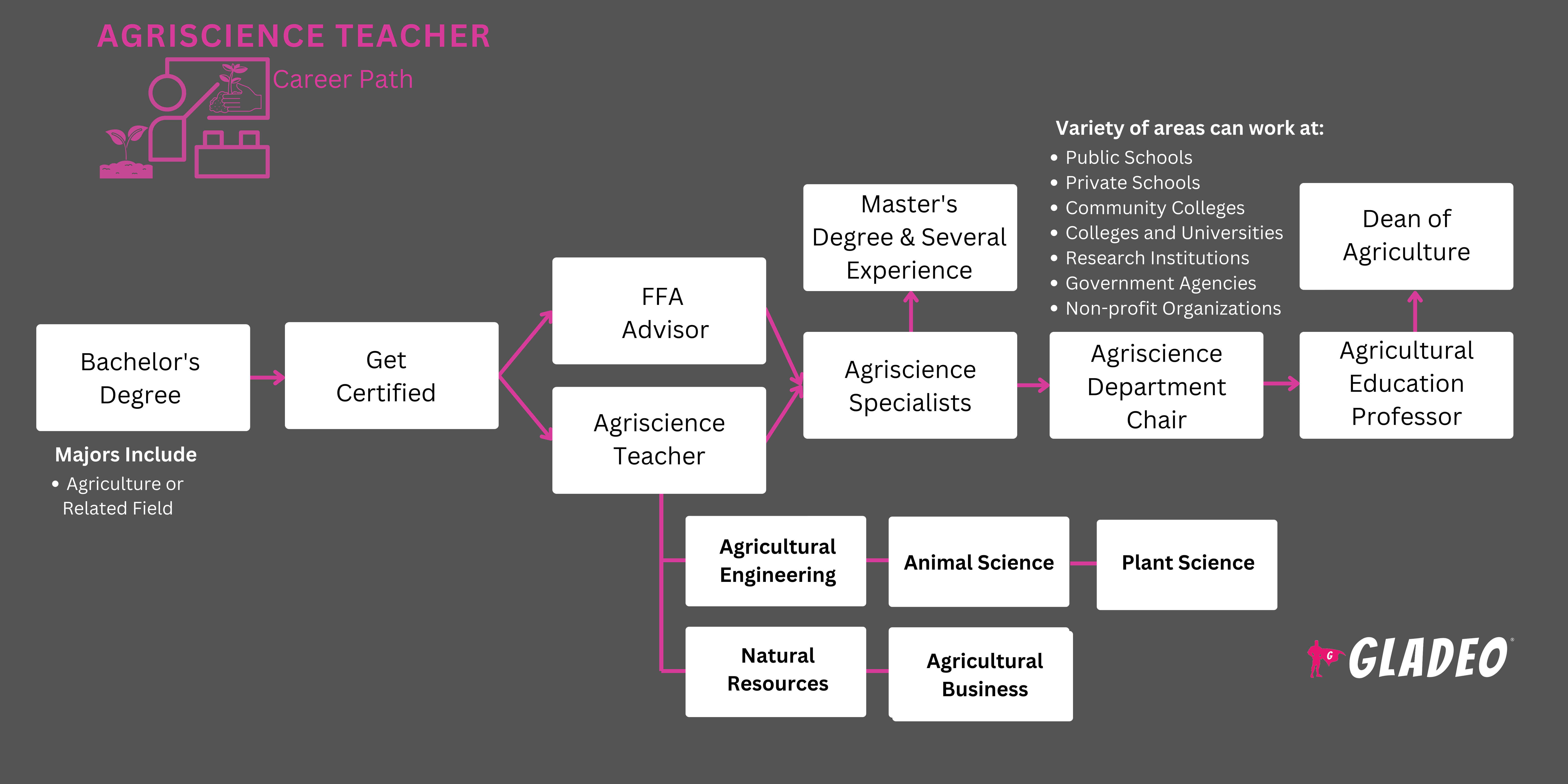
- Most K-12 Agriscience Teachers have a bachelor’s degree in agriculture, agriculture science, or agriculture education
- Common courses include animal science, crop science, horticulture, natural resources, and agricultural education. Future teachers will also take classes such as teaching pedagogy and educational psychology
- STEM college programs should typically be accredited by ABET
- Public K-12 teachers need to be state licensed or certified; however, private schools and college-level teachers don’t require licensure
- To get licensed, public school teachers must finish a teaching program in college, pass a background check, and pass general and subject matter exams
- General exam options are the Praxis (administered by ETS) and National Evaluation Series (administered by Pearson)
- Requirements vary by state. Note, most states also offer alternative certification programs for K-12 teachers.
- To teach STEM subjects at a college level, you’ll need a minimum of a master’s for instructor positions, and a doctorate if you want to be a professor
- Dapat sikapin ng lahat ng guro na matutunan at itaguyod ang Pagkakaiba-iba, Pagkakapantay-pantay, at Pagsasama
- K-12 teachers can obtain a National Board of Professional Teaching Standards certification after three years of teaching experience
- Look for ABET-accredited colleges offering majors in agriculture, agriculture science, or agriculture education, as well as programs offering a teaching program
- Maghanap ng mga programang may mga internship o mga pagkakataon upang makakuha ng praktikal na karanasan
- Paghambingin ang mga gastos sa matrikula at bayarin, na isinasaalang-alang ang mga gastos sa loob ng estado kumpara sa mga gastos sa labas ng estado
- Suriin ang mga opsyon sa scholarship at tulong pinansyal
- Isaalang-alang ang mga istatistika ng pagtatapos at pagkakalagay sa trabaho para sa mga alumni
- Ask your teachers for guidance and mentorship about becoming a teacher!
- Magpasya kung gusto mong magturo sa elementarya, middle school, high school, o kolehiyo
- Volunteer to help teachers so you can understand the daily routine
- Pay extra attention in STEM and agriculture-related classes, but also hone your English, writing, public speaking, and project management skills!
- Participate in clubs and activities, including the Supervised Agriculture Experience and Future Farmer of America
- Volunteer with youth in youth organizations, religious activities, summer camps, etc.
- Seek roles that offer leadership and organizational skills practice
- Read articles and watch videos related to agriscience
- Kung kukuha ka ng programa sa pagsasanay ng guro, gumawa ng malakas na impresyon, higupin ang lahat ng kaalamang kaya mo, at subaybayan kung ano ang epektibo at kung ano ang hindi.
- Look for opportunities to substitute teach or aid teachers
- Sign up for STEM bootcamps or online courses like the ones offered by edX or Udemy
- Subaybayan ang iyong mga nagawa para sa iyong resume at/o mga aplikasyon sa kolehiyo
- Scan job portals like Indeed.com, EdJoin.org, Glassdoor, ZipRecruiter, and other sites
- Look at the career pages of the school district or college websites
- Having agriculture-related work experience might make you a more competitive applicant. If you want to work directly in an ag-related job before teaching, check out:
- AgriculturalCrossing
- EcoFarm (Asosasyon ng Ekolohikal na Pagsasaka)
- Farm and Ranch Jobs
- Many Agriscience Teachers start as teacher assistants to gain experience in the classroom. Assistant roles may only require an associate’s degree
- Consider starting as a substitute teacher or tutor. Tutors are in high demand in many areas due to nationwide teacher shortages
- List all practical experience you have of working with youth, including internships or volunteerism
- Magtanong sa iyong network para sa mga lead tungkol sa mga paparating na bakanteng trabaho. Karamihan sa mga trabaho ay matatagpuan sa pamamagitan ng mga koneksyon!
- Keep up-to-date on agriscience developments because things change quickly
- Ask former professors and supervisors for their consent to list them as references
- Research potential employers (i.e., K-12 school districts, trade or vocational schools, community colleges, universities, online schools, etc.). Learn their mission, values, and priorities so you can find a good match
- Consider starting your job search in areas where there are high teacher-to-student vacancy rates. But try to find out why those shortages exist, in case it is not a good match for you
- Suriin ang mga halimbawang resume ng guro at mga tanong sa panayam para sa guro
- Remember, there are different templates and interview questions for different teaching levels. Someone applying to a university faculty position won’t have the same application process as a K-12 teacher
- Professors usually need a CV listing their relevant publication history and may need to submit research, teaching, and diversity statements
- Conduct mock interviews with friends or your educational program’s career center
- Demonstrate awareness of trends and terminology during interviews
- Articulate your enthusiasm for working with youth or young adults
- Alamin kung paano manamit para sa isang panayam sa guro
- Consider relocating to where there are more (or higher-paying) job openings!
- K-12 teachers can move up by teaching at advanced levels. Knock out extra education and training, such as a higher-level degree or a new certification
- Some teachers shift from teaching to administrative roles, which may involve getting a degree in education or school administration
- Kapag mayroon ka nang sapat na karanasan, kumuha ng opsyonal na sertipikasyon mula sa National Board of Professional Teaching Standards upang mapalakas ang iyong resume.
- Most postsecondary STEM educators have a doctorate. Those who don’t (such as instructors) may need one to qualify for a tenure track full professor position
- If you're a college faculty member on a tenure track, stay on top of the requirements as you progress from assistant to associate to full professor!
- Get specialized in a challenging STEM area like artificial intelligence by taking advanced courses (Yes, AI is impacting nearly every industry, including agriculture!)
- Grow your reputation as a subject matter expert. Get published in agriscience journals, write online articles, make tutorial videos, mentor peers, and participate in alumni professional organization events
- Make your own website or social media channel related to your area of expertise, where users can learn and share information
- Serve on high-visibility school and district committees
- Palakasin ang ugnayan sa mga mag-aaral, kawani, guro, at administrador
- Be creative! Explore innovates ways to teach STEM (and STEAM) subject matter to keep learners motivated
Mga Website
- ABET
- American Association for Agriculture Education
- Amerikanong Asosasyon para sa Pagsulong ng Agham
- Pederasyon ng mga Guro ng Amerika
- Samahang Amerikano para sa Agham Hortikultural
- Samahang Amerikano ng Agronomiya
- Center for Disease Control
- Samahan ng Agham ng Pananim ng Amerika
- Kagawaran ng Agrikultura
- Ahensya ng Proteksyon sa Kapaligiran
- Serbisyo sa Kagubatan
- National Association of Agricultural Educators
- Pambansang Lupon ng mga Propesyonal na Pamantayan sa Pagtuturo
- National Council for Agricultural Education
- Pambansang Asosasyon ng Edukasyon
- Pambansang Samahan ng mga Alumni ng FFA
- Pambansang Instituto ng Pagkain at Agrikultura
- Mga Pambansang Institusyon ng Kalusugan
- Pambansang Samahan ng mga Magulang at Guro
- Serbisyo ng Pambansang Parke
- Pangangalaga sa Kalikasan
- TEACH.org
- Ang Pambansang Akademya ng Agham
- Pangasiwaan ng Pagkain at Gamot ng Estados Unidos
- Serbisyo ng Inspeksyon sa Kalusugan ng Hayop at Halaman ng USDA
Mga Libro
- Agriscience: Fundamentals and Applications, by L. DeVere Burton
- Introduction to Agronomy: Food, Crops, and Environment, by Craig C. Sheaffer
- Lab Manual to Accompany Exploring Agriscience, by Ray Herren
Modern teachers are often pulled in a thousand directions at once, as they juggle their teaching duties as well as try to manage additional responsibilities for taking care of students. EducationWeek pointed out that current rates of teacher job satisfaction are low compared to previous years. Things may improve over time, and of course, not everyone’s experiences are the same. But if you’re interested in reviewing other educational career options, consider the below similar occupations:
- Tagapayo sa Akademiko
- Adult Education Teacher
- Tagapayo sa Karera
- Dekano ng mga Mag-aaral
- Elementary, Middle, and High School Principal/Vice Principal
- ESL Teacher
- Financial Aid Officer
- Yamang-Tao
- Tagapag-ugnay ng Instruksyon
- Military Training Instructor
- Private Tutor
- Tagapagrehistro
- ROTC Instructor
- Nars sa Paaralan
- Guro sa Espesyal na Edukasyon
- Tagapagsanay sa Palakasan
- Superintendente
- Veterans Affairs Designated Education Officer
If you’re more interested in the agricultural side of things, consider the following options:
- Tekniko ng Agrikultura at Agham ng Pagkain
- Inhinyero sa Agrikultura
- Biochemists and Biophysicist
- Biyologo
- Tekniko ng Kemikal
- Siyentipiko sa Konserbasyon at Manggugubat
- Siyentipiko at Espesyalista sa Kapaligiran
- Magsasaka, Rancher, at Tagapamahala ng Agrikultura
- Ekolohista ng Industriya
- Mikrobiyologo
- Tekniko ng Agrikultura ng Presyon
- Beterinaryo
- Zoologist at Biyolohikal ng mga Hayop
Balita

Mga Itinatampok na Trabaho
Mga Online na Kurso at Kagamitan
Mga Inaasahang Taunang Sweldo
New workers start around $55K. Median pay is $76K per year. Highly experienced workers can earn around $101K.
Mga Inaasahang Taunang Sweldo
New workers start around $72K. Median pay is $103K per year. Highly experienced workers can earn around $134K.
Mga Inaasahang Taunang Sweldo
New workers start around $63K. Median pay is $90K per year. Highly experienced workers can earn around $117K.